

Digital Twin Stroke Care Network at Prince of Songkla University and Bangkok Hospital

(Hat Yai, Thailand | 13–15 July 2026) Researchers from the London Digital Twin Research Centre, Middlesex University London, together with collaborators from Universitas Gadjah Mada (UGM), Indonesia, participated in The 20th Postgraduate Forum on Health Systems and Policies, hosted by the Faculty of Medicine, Prince of Songkla University (PSU), Thailand, on 13–14 July 2026.

The conference brought together researchers, clinicians, and policymakers from across the region to exchange ideas on digital health, artificial intelligence, health systems, and healthcare innovation. Through oral and poster presentations, the team shared ongoing collaborative research while strengthening international partnerships in digital stroke care.

Showcasing Collaborative Research

Dr Annisa Ristya Rahmanti, Postdoctoral Researcher at the London Digital Twin Research Centre (TECHLEAD Program), presented research evaluating how different prompting strategies influence the quality and consistency of large language model (LLM)-generated stroke rehabilitation care plans. The study contributes to the growing evidence base for the safe application of generative AI in clinical decision support.

The conference also showcased research from UGM postgraduate student working within the Network:

  • Ika Agustin Atika Putri presented a machine learning study predicting prolonged hospital length of stay among stroke patients using Indonesian National Health Insurance claims data.
  • Marcellino Maatita presented an umbrella review examining health system interventions that reduce treatment delays in acute ischaemic stroke.
  • Muhammad Shabri Putra Wibowo presented a scoping review exploring the maturity and clinical applications of digital twin technologies in hospitals.

Together, these presentations highlighted the Network’s multidisciplinary research spanning artificial intelligence, predictive analytics, evidence synthesis, and digital twin technologies to support data-driven stroke care.

Learning from Bangkok Hospital’s Digital Transformation

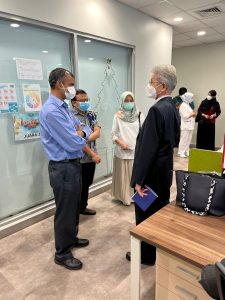
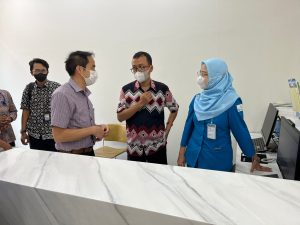
Following the conference, the team visited Bangkok Hospital Hat Yai on 15 July 2026 to explore its digital transformation programme.

The visit demonstrated how digital technologies have been integrated across the entire patient journey, from AI-assisted pre-arrival services and paperless registration to real-time patient flow management, operational dashboards, and Sandbox Care+, a clinical decision support platform designed to improve adherence to evidence-based clinical practice guidelines.

The discussions also covered clinician engagement, digital transformation strategies, AI governance, and future opportunities for integrating emerging technologies such as large language models into hospital information systems while maintaining patient safety and clinical reliability.

Strengthening International Collaboration

Participation in the conference and hospital visit reinforced the Digital Twin Stroke Care Network’s commitment to international collaboration in digital health research. By combining expertise from the United Kingdom, Indonesia, and regional healthcare partners, the Network continues to advance innovative, evidence-based approaches to improve stroke care through artificial intelligence, digital twins, and learning health systems.

Digital Twins and AI in Transforming Public Health

 YOGYAKARTA, 3 July 2026 – The 16th UGM Public Health Symposium (PHS 16) served as a prominent platform for showcasing cutting-edge technological innovations in healthcare. The event prominently highlighted robust international academic and research collaborations, notably demonstrated through the closely aligned work of the speakers, Prof. Huan X. Nguyen (Director of the Digital Twin Research Centre at Middlesex University London) and Dr. Ari Prayogo Pribadi (Postdoc under TECHLEAD Program).  Together, they bring a shared grand vision of utilising dynamic virtual replicas (Digital Twins) and Artificial Intelligence (AI) to advance disease prevention and public health education.

Prof. Huan Nguyen delivered an online invited lecture, sharing insights into digital twin technologies for healthcare

Continue reading “Digital Twins and AI in Transforming Public Health”

Third ECRs Seminar Series @SAT MDX Featuring International Experts in AI, Control Systems, and Disaster Resilience

London, UK (1 July 2026) – The London Digital Twin Research Centre (LDTRC) at Middlesex University London successfully hosted its third monthly PhD/Postdoctoral Workshop Series at the Faculty of Science and Technology, bringing together academics, researchers, postdoctoral fellows, and doctoral students for a multidisciplinary exchange of ideas spanning artificial intelligence, engineering, communication networks, and disaster resilience. The event forms part of LDTRC’s ongoing commitment to supporting early career researchers (ECRs), fostering interdisciplinary collaboration, and strengthening international research partnerships.

The 3rd Seminar Series was opened by Professor Huan X. Nguyen and chaired by Dr Mifetika Lukitasari.

Continue reading “Third ECRs Seminar Series @SAT MDX Featuring International Experts in AI, Control Systems, and Disaster Resilience”

Advancing Stroke Care and NCD Prevention Through Responsible AI: Oxford Workshop Brings Together UK, Indonesian, and Vietnamese Partners

Oxford, United Kingdom (24 June 2026) – The London Digital Twin Research Centre (LDTRC), Middlesex University London, in collaboration with the University of Oxford, successfully convened the international workshop “Advancing Stroke Care and Non-Communicable Disease Prevention Through Responsible AI and Digital Innovation” at Corpus Christi College, Oxford.

The workshop also marked the official launch of the UK–Indonesia–Vietnam Transnational Education (TNE) Partnership, supported by the British Council Going Global Partnerships (GGP) Programme (https://dt.mdx.ac.uk/?p=3152), while showcasing ongoing collaborative research funded through the British Council International Science Partnerships Fund (ISPF) – StrokeDT (https://dt.mdx.ac.uk/?page_id=326). Bringing together researchers, clinicians, policymakers, educators, and students from the United Kingdom, Indonesia, and Vietnam, the event explored how responsible artificial intelligence (AI), digital innovation, and international collaboration can strengthen health systems, improve stroke care, and accelerate progress in the prevention and management of non-communicable diseases (NCDs).

Prof Arjune Sen

Opening the event, Prof. Arjune Sen, Consultant Neurologist at Oxford University Hospitals NHS Foundation Trust, and Director of the Centre for Global Epilepsy, welcomed participants and highlighted the importance of international collaboration in addressing the growing global burden of neurological disorders and other non-communicable diseases.

Continue reading “Advancing Stroke Care and NCD Prevention Through Responsible AI: Oxford Workshop Brings Together UK, Indonesian, and Vietnamese Partners”

London Digital Twin Research Centre Hosts Second Research Seminar Series for ECRs

London, UK – The London Digital Twin Research Centre (LDTRC) at Middlesex University successfully hosted the second session of its monthly Research Seminar Series on Wednesday, 3 June 2026, bringing together faculty members, doctoral researchers, postdoctoral fellows, and early career researchers to share innovative research and foster interdisciplinary collaboration.

Hosted and organised by the LDTRC, the seminar series is held on the first Wednesday of each month and provides a platform for students and early career researchers (ECRs) to present their work, exchange ideas across disciplines, engage with invited talks from established academics, and strengthen research collaboration across the Faculty of Science and Technology.

Continue reading “London Digital Twin Research Centre Hosts Second Research Seminar Series for ECRs”

Early Career Researchers Showcase International Collaboration at Medical Informatics Europe (MIE) 2026

Genoa, Italy – Researchers from the UK-Vietnam-Indonesia Digital Twin Stroke Care Network (DTStrokeCare) successfully delivered oral presentations at the Medical Informatics Europe (MIE) 2026 Conference, held in Genoa, Italy, from 25–28 May 2026.

The network was represented by Dr. Annisa Ristya Rahmanti, an Early Career Research (ECR) Fellow participating in the British Council TECHLEAD Fellowship Programme, and Ika Agustin Atika Putri, a Master’s student in Health Policy and Management at the Faculty of Medicine, Public Health and Nursing (FK-KMK), Universitas Gadjah Mada, Indonesia. Both researchers presented oral papers showcasing ongoing studies conducted within the DTStrokeCare Network and supported by the StrokeDT grant funded through the British Council’s International Science Partnerships Fund (ISPF) Research Collaborations Programme.

Dr Annisa Ristya R
Ika Agustin Atika Putri

Continue reading “Early Career Researchers Showcase International Collaboration at Medical Informatics Europe (MIE) 2026”

ECR Fellows Launch Research Workshop Series

On Wednesday 6 May 2026, the Early Career Research (ECR) Fellows participating in the British Council fellowship programme TECHLEAD officially launched a new research workshop series for postgraduate researchers and postdoctoral fellows within the Faculty of Science and Technology at Middlesex University London. The series aims to provide a collaborative platform for researchers to present their latest work, exchange ideas, and engage with invited speakers from both academia and industry. Humanity, naturally, has decided that the best way to generate knowledge is to place stressed researchers in a room with PowerPoint slides and questionable coffee. Occasionally, it works remarkably well.

Hosted and organised by the London Digital Twin Research Centre (LDTRC), the monthly workshops will take place on the first Wednesday of each month at 11:00am in TG23, Town Hall Building, Middlesex University London. You are all welcome to attend. The inaugural workshop was a strong success, featuring presentations from seven postdoctoral researchers currently working within LDTRC across a range of digital twin and emerging technology research areas. Future sessions will expand to include talks from PhD researchers as well as invited internal and external speakers, further strengthening interdisciplinary collaboration and research exchange within the Faculty, Centre and beyond.

Some snapshots of the talks in the first workshop:

Together

Continue reading “ECR Fellows Launch Research Workshop Series”

TNE grants on stroke care, digital twinning, quantum and 6G

40 Years of Wireless Evolution

Dr Mallik Tatipamula, the CTO of  Ericson Silicon Valley and LDTRC’s advisor, together with Dr. Vinton Cerf from Google,  wrote a nice piece on IEEE Spectrum outlining the 40 years of wireless evolution: The path from 1G to 6G tracing from dumb pipes to a nervous system, leading to a smart, sensing network. 

Wireless Evolution

They wrote: “Every generation of mobile networks, from 1G to 5G, has rewritten the rules of how the world lives and works. The coming 6G revolution, by decade’s end, will represent a new direction still, toward a universal data fabric where millions of agents collaborate in real-time across the digital and physical worlds.

The story of wireless connectivity is often told in speeds and standards—megabits per second, latency, and spectrum bands. But these generational shifts in device specs obscure a deeper pattern. Each generation, from 1G to 5G, rewrote the relationships between three elements: the Devices we carry, the Networks that connect them, and the Applications that run on them. We call this connectivity’s DNA. With 6G, that DNA of interconnection is about to change fundamentally.

As with the “7 Phases of the Internet”—an article we published with IEEE Spectrum last October—mobile networks’ 6 generations follow a similar arc toward system-wide intelligence. That arc traces through every generation of wireless, revealing a steady advancement of the reach and scope of connectivity itself.”

Seven phases of the Internet

You can read it in full here.

Project ‘Vertical Farming’ highly commended by the British Council

Summary of the vertical farming project

See more details of the awards here.